Elevate your talent attraction and retention with free employee benefits. Uncover a platform that effortlessly entices, engages, and retains your valuable staff.
Get a free demoSee how leading healthcare organisation Healius turned turnover into triumph with Flare.
Read Healius’ storyDevelop your business skills and HR expertise with the Flare Benefits Resource Hub. Get access to helpful tools, articles, guides, webinars, and other on-demand resources that can help your business attract, hire, and retain top talent.
Explore insights from our comprehensive survey of 1500+ Australian workers across a variety of industries, revealing the benefits that genuinely make an impact.
Still haven't found what you're looking for? We're here to help.
Get in touchAuthor: Danny Thai | 10 Jun 2026
Chattel mortgages are one of the most common ways Australian businesses finance vehicles. They offer ownership from day one, predictable repayments, and a range of tax benefits that standard car loans do not. For businesses already using this product, the question is increasingly becoming: does it make sense to finance an electric vehicle on a chattel mortgage?
The answer, for many businesses, is yes. And the reasons go beyond the environment.
A chattel mortgage is a business loan used to purchase a vehicle or piece of equipment, where the asset itself secures the loan. The business takes ownership of the vehicle at the time of purchase, not at the end of the term. The lender registers an interest in the asset until the loan is repaid.
Key features:
For GST-registered businesses, a chattel mortgage also allows you to claim the GST on the full purchase price upfront on your next BAS statement, rather than in smaller increments over time. Interest paid on the loan is tax-deductible proportional to business use, and the vehicle can be depreciated as an asset on your balance sheet.
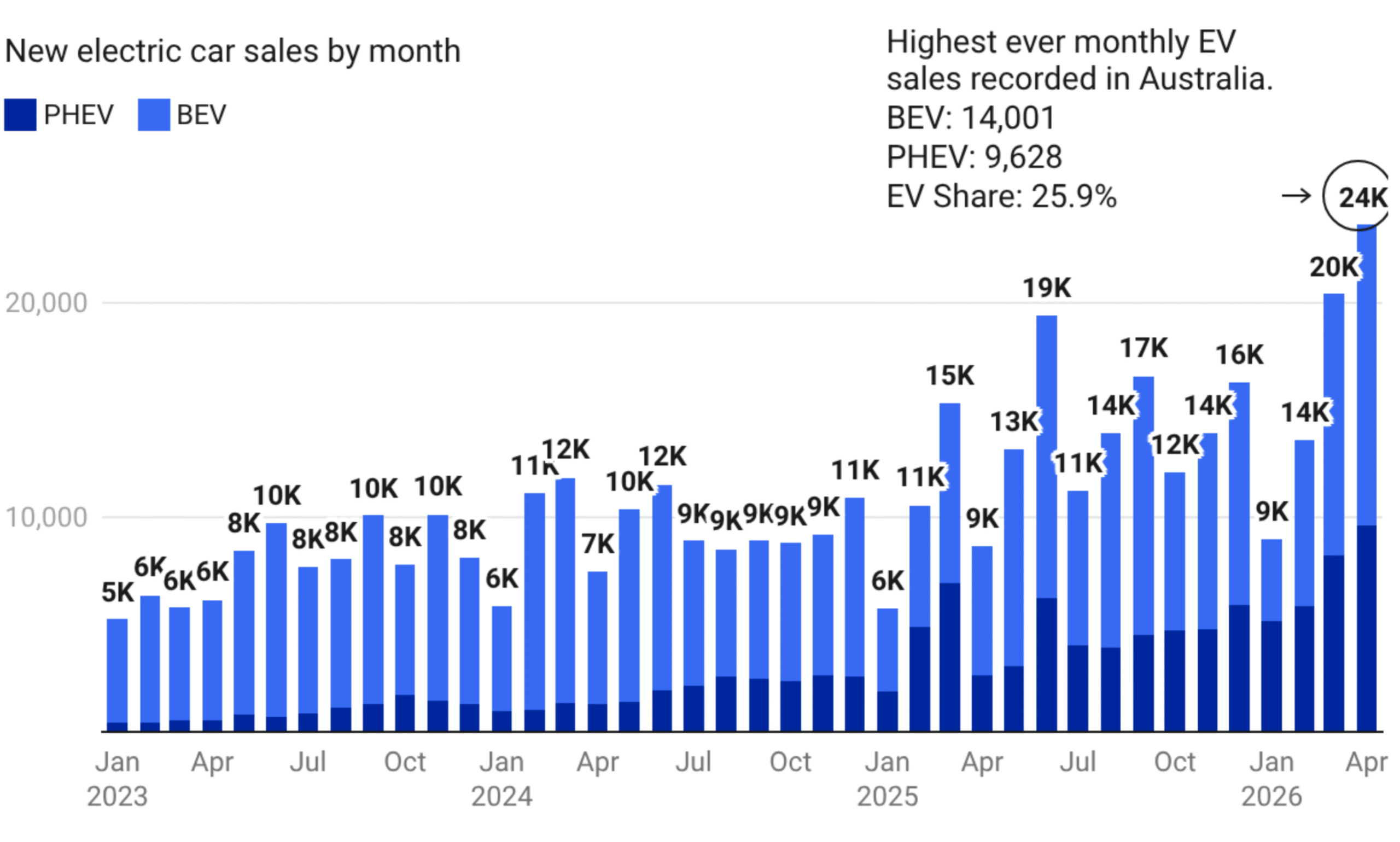
Electric vehicle adoption in Australia has picked up significantly. In 2025, Australians bought more than 156,800 electrified vehicles (BEVs and PHEVs combined), a 38.7% increase on 2024. Battery electric vehicle (BEV) sales exceeded 100,000 for the first time, and plug-in hybrid (PHEV) sales nearly doubled. More recently, EV sales are hitting record highs, with almost 3 in 10 new car sales being electric in April 2026.
Chart: zecar • Source: FCAI, EVC • Created with Datawrapper
Despite this growth, business uptake of EVs has lagged behind consumer uptake. Many businesses are still running petrol or diesel vehicles, which means there is both an opportunity and a cost saving on the table. In times of volatile fuel prices and tightening margins, businesses are increasingly looking to EVs as a way to reduce operating costs.
The most obvious argument for EVs in a business context is lower running costs.
Charging an EV at home or at a business premises typically costs ~$5 per 100km compared to an equivalent petrol vehicle at $16 per 100km – that’s close to a 70% saving. Annual savings however will depend on distance travelled, charging costs and fuel prices paid. Fuel prices in Australia have been volatile so far in 2026, averaging between $1.85 and $2.20 per litre across capital cities.
With EVs, the savings become more significant the more you drive. Those that cover longer daily distances such as couriers and rideshare drivers will reap the biggest cost savings.
Charging type
Cost
Cost per 100km
Home/work charging
$0.35/kWh
$4.86
Public charging
$0.70/kWh
$9.21
Petrol
$2.0/L
$16.00
Diesel
$2.3/L
$18.40
Lower servicing costs are the other major reasons EVs have lower running costs. EVs have fewer moving parts: no engine oil, no timing belt, no exhaust system, no transmission fluid. Brake pads last longer due to regenerative braking. Over five years, businesses can expect to save thousands in servicing costs compared with an equivalent petrol vehicle
These maintenance savings apply primarily to fully electric vehicles. Because Plug-in Hybrid Electric Vehicles (PHEVs) still have an internal combustion engine, they still require traditional servicing like oil changes and fluid checks, though they do benefit from reduced brake wear.
EVs have historically cost more upfront than petrol equivalents. That gap is narrowing every year. There are now EV models in every segment where an electric option exists that is a similar price or cheaper than a petrol or diesel equivalent.
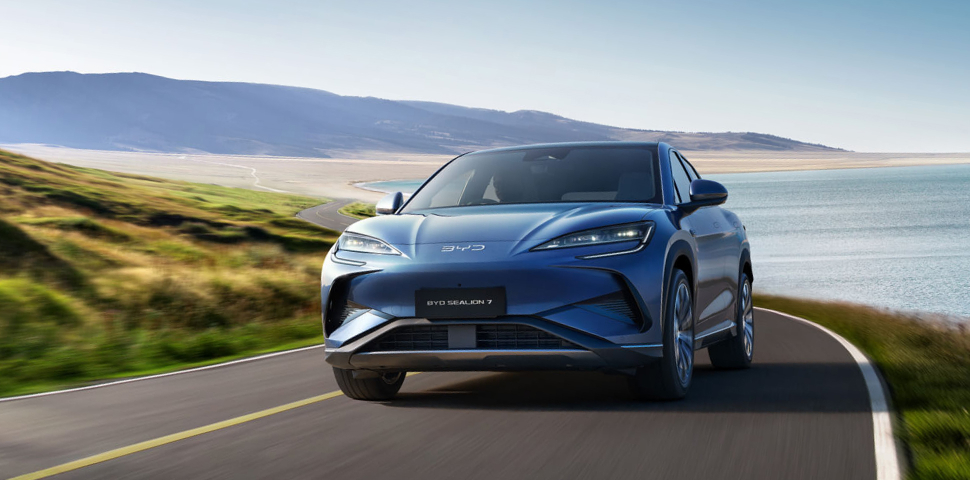
For example in the mid-sized petrol SUV segment a mid range Toyota RAV4 Cruiser is $62,247 driveaway. There are now several electric SUVs priced lower: Geely EX5 Complete ($46,000 driveaway), BYD Sealion 7 Premium ($59,270 driveaway) and Tesla Model Y RWD ($64,000 driveaway).
Trade professionals have more electric and hybrid options than ever. The BYD Shark Premium plug-in hybrid ute starts at $62,660 drive-away, around $10,000 less than the Ford Ranger Wolftrak ($73,000 driveaway).
The expanding range of comparatively affordable EVs means price is increasingly less of a barrier for businesses looking to switch.
Below is a comparison or ownership costs between two popular and similarly sized petrol and electric cars.
Toyota RAV4 Cruiser 2WD
BYD Sealion 7 Premium
Driveaway price
$62,247
$59,270
Registration, insurance, tax
$11,910
$11,281
Service, maintenance, tyres
$6,162
$3,119
Fuel (energy)
$10,880
$3,488
Total after tax cost 5 years
$91,199
$77,158
Estimated savings
$14,040
Figures are illustrative. Based on 15,000 km/year, $2.0/L petrol average, flat electricity tariff $0.30/kWh. Individual results will vary.
When your business finances an EV through a chattel mortgage, the same tax advantages apply as with any business vehicle:
These benefits apply regardless of whether the vehicle is electric or petrol. The advantage of an EV is that lower running costs reduce other business expenses on top of the existing financing tax benefits.
Tax outcomes depend on your business structure, GST registration, vehicle use percentage, and individual circumstances. Always seek advice from a qualified accountant before making finance decisions.
If you operate your business under a company structure, and provide an electric vehicle provided to an employee (including a director who is also an employee of the business), you may be able to take advantage of the federal government’s FBT exemption for electric cars.
Under this exemption, eligible battery electric vehicles provided to employees for private use are exempt from Fringe Benefits Tax (FBT). Without the exemption, FBT applies at 47% on the taxable value of the benefit, which can significantly increase the effective cost of providing a vehicle.
To qualify, the vehicle must:
The FBT exemption remains in full until 31 March 2027. From April 2027, EVs priced between $75,000 and the LCT threshold will receive only a 25% FBT discount. From April 2029, the full exemption ends.
A small business owner operates through a company structure and purchases a BYD Sealion 7 Premium BEV via a chattel mortgage, making it available to an employee for private use.
Toyota RAV4 Cruiser 2WD
BYD Sealion 7 Premium
Driveaway price
$62,247
$59,270
FBT applicable?
Yes
No
Statutory FBT rate
20% of value
$0
FBT Taxable value
$12,305
$0
Adjusted FBT Value
(40% personal use)
$4,922
$0
FBT payable (at 47%)
$2,313
$0
Annual FBT saving
$2,313
The FBT exemption does not depend on the finance method: it applies whether the vehicle is purchased outright, via chattel mortgage, or through another business finance structure.
The key is that the vehicle must be provided to an employee (including company directors) and meet all ATO eligibility criteria.
Choosing an electric vehicle financed through a chattel mortgage can make financial sense for businesses that:
Not every business is the same. The right vehicle and finance structure depends on your business use, entity type, and tax position.
Flare Cars offers chattel mortgages for businesses looking to add electric vehicles to their operations. Our team can help you understand your options and structure a deal that works for your cash flow.
This article contains general information only and is not financial or tax advice. Tax outcomes depend on your individual circumstances. Always consult a qualified accountant or financial adviser before making vehicle finance decisions. FBT rules are based on ATO guidance current as at the date of publication and are subject to change.