Login

State of EVs in Australia in 2026: Prices, Models, Charging and Trends

Author: Danny Thai   |   19 May 2026

One of the most common questions Australians still ask about electric vehicles is whether they ‘have enough range?’. ‘Range Anxiety’ is an understandable concern, for some, but it is also one that is often based more on perception than everyday driving reality. While Australia is geographically large, most people do not drive extreme distances each day, 90% live in urban areas and modern EVs now offer far more range than many realise.

For a large share of households, an electric car can comfortably handle commuting, school runs, shopping trips, weekend outings and even many road trips. Longer drives (400km+) however may require more planning, particularly if undertaken during school holidays and long weekends.

The real question is usually not whether EVs suit Australia, but whether they suit your personal driving habits.

If you are comparing costs...

It can also be worth getting a quote for an EV novated lease to see how salary packaging may improve affordability.

Calculate your savings

How Far Do Australians Actually Drive?

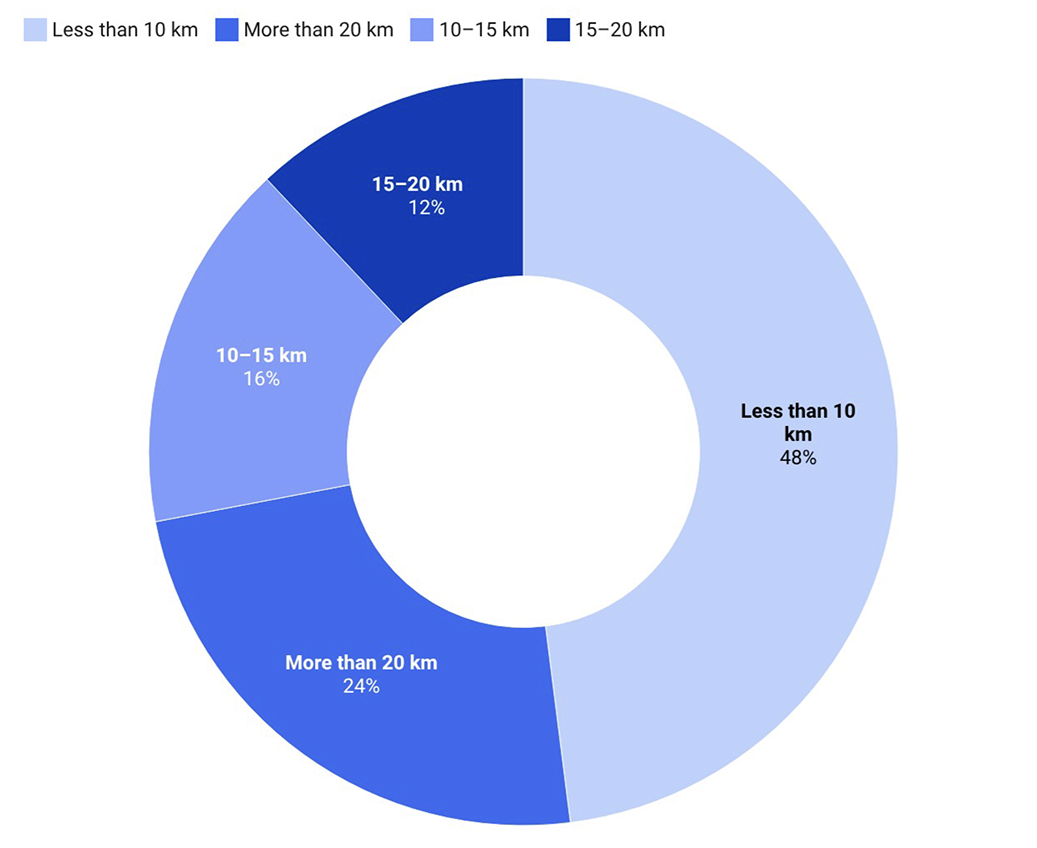
Despite the common belief that Australians spend their lives covering huge distances, average daily driving is usually far lower than people expect. The average distance covered in Australia is 37km per day, with some drivers doing less and some doing more depending on location and work needs. Below is a breakdown of driving distances in Australian capital cities.

Average daily commute distance in Australian capital cities

Source:  https://www.bitre.gov.au/sites/default/files/is_073.pdf • Created with Datawrapper

That means a vehicle with 400 km of usable range could comfortably cover a week of normal driving for most people before needing to recharge. For households with home charging, topping up overnight often replaces the need for regular petrol station visits.

Did You Know?

The average electric car in Australia has a range of 466km on a full charge. That is 80%more than the average weekly distance of a driver in Australia.

Source: zecar.com

It is clear from the data that EVs are suitable vehicles for the significant majority of the
population for regular daily commutes.

City Driving vs Regional Driving

City Drivers

Drivers in cities such as Sydney, Melbourne and Brisbane often spend more time in traffic, cover shorter distances and drive at lower average speeds. This is where EVs perform strongly, as stop start driving can actually improve efficiency through regenerative braking.

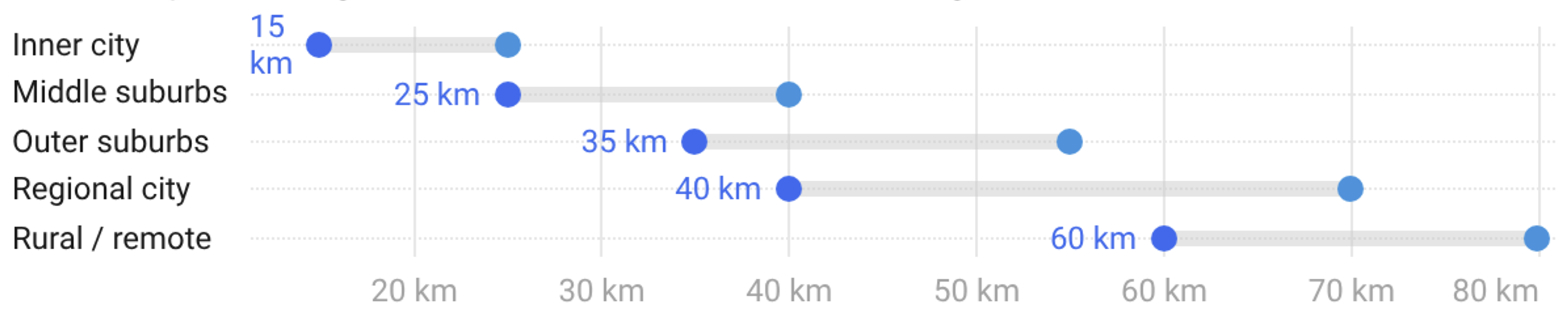
Many urban households can often go well over a week between charges, especially when charging at home. City drivers drive on average less than regional/rural based on the data available.

Average daily commute distances in Australian capital cities by loction

Sources: Various, including: https://www.bitre.gov.au/sites/default/files/is_073.pdf • Created with Datawrapper

Regional Drivers

Regional Australians often travel longer distances at higher speeds, which means range becomes more important. However, that does not mean EVs are unsuitable. It simply means selecting an EV with the battery size and checking charging routes matters more.

Location

Average Daily Commute

Regional city

40 to 70 km/day

Rural / remote

60+ km/day

A driver based in a regional town who mainly uses the car locally may need no more range than a city driver. Someone regularly travelling between towns may prefer a longer-range EV with faster charging capability.

If you regularly drive long distances for work...

A quote for an EV novated lease can help compare whether a longer-range EV stacks up financially.

Outer Suburbs vs Inner City

Outer suburban households drive on average more than inner-city households due to longer commutes, school activities and larger weekly shopping trips. Various studies indicate the commute difference could be double in favour of outer suburban drivers. Inner-city residents may drive less, but they can face another challenge: access to off-street parking and convenient charging.

These price reductions have been supported by a mix of lower manufacturing costs, more Chinese brands entering the market, and stronger competition across most segments.

While EVs are still on average more expensive than petrol vehicles, in most segments, there are several EV models that have reached price parity, making the upfront cost less of a barrier than it once was. The EV price premium will continue to reduce and with EVs expected to reach average price parity with petrol vehicles in the next 24 months.

Average car prices across fuel types

Location

Average Daily Commute

Inner city

15 to 25 km/day

Middle suburbs

25 to 40 km/day

Outer suburbs

35 to 55 km/day

For outer suburbs, daily kilometres are often still well within the capability of mainstream EVs. A 60 km round trip commute is manageable for many models without needing to top-up daily.

For inner-city residents, public charging access or workplace charging can be just as important as battery range.

Despite the differences in average commute distances, the range of an ‘average’ EV (466km) is more than capable of meeting most day-to-day needs.

EV Range on Road Trips

Road trips are where range concerns are most common, but they are also where EV capability is often underestimated. Many current EV models can comfortably cover 350 km to 600 km or more between charging stops on the highway, depending on the model, speed
and conditions.

Highway driving usually reduces EV range compared with city driving. At higher speeds, wind resistance increases significantly, which means more energy is consumed to maintain speed. As a result, an EV rated at 450 km will range on a highway trip than during mixed suburban driving. For example if the average speed on a highway trip is 100 km/hr, an EV rated at 450km of range, would likely only achieve ~360km at those speeds.

Notwithstanding the impact of speed on range, many common Australian road trips can still be comfortably completed with one charging stop or none at all.

Examples:

  • Sydney to Canberra can be achievable in many EVs with little or no charging required
  • Melbourne to Bendigo is well within the range of nearly all EVs
  • Brisbane to Gold Coast is covered by all EVs

Longer trips simply require planned charging stops, often aligned with meal, coffee or bathroom breaks.

Chasing Cars recently completed an experiment comparing the time taken to travel between Sydney and Melbourne in a Tesla Model 3 (EV) and Toyota Camry Hybrid. The Tesla Model 3 took only 9 minutes longer despite having to stop for a charge twice along the way. This is
because most EV owners will align their charging stop with a rest break, meaning little time is lost.

Australia’s fast charging network continues to grow across highways, regional towns and tourist routes, making EV road travel easier each year.

So are EVs a Good Fit for Australian Distances?

For the significant majority of Australians, the answer is yes.

The idea that EVs cannot handle Australian distances often comes from focusing on occasional road trips rather than normal weekly driving. In reality, most driving is local, predictable and comfortably within the range of many modern EVs. Australia is a large country, but most people are not driving across it regularly, if at all.

Modern EVs already suit many commuters, suburban families, city households and a growing number of regional drivers. The key is choosing a vehicle that matches your lifestyle and driving habits, rather than relying on outdated assumptions about range.

The better questions to ask are:

  • How far do I drive most days?
  • Can I charge at home or nearby?
  • How often do I take long highway trips?
  • Do I need maximum range every day, or only occasionally?

Once drivers look at their real usage, EV suitability often becomes much clearer.

If you are considering the switch...

Get a quote for an EV novated lease to compare costs, tax savings and available vehicle options.

Electric vehicles are growing quickly in Australia, with more people making the switch each year as prices fall and more models become available. Global events since the start of the year have further accelerated interest in EVs, adding momentum to an already rapidly growing market.