Login

EV Myths Busted: Do Electric Cars Really Lose Value Faster?

Author: Danny Thai   |   29 July 2026

Resale value is one of the biggest worries buyers raise about EVs. The idea is that electric cars lose value faster than petrol or diesel cars, so you end up worse off when you sell.

The truth is more mixed than the myth suggests. Some EVs do depreciate faster than the average petrol car. Others hold their value about as well. Industry averages for EV resale values are not widely available so we crunched the numbers (and compared them to typical petrol and diesel depreciation benchmarks) on two of the best selling EV models over the last several years.

Source: Everything Electric

How we worked out the numbers

We looked at two popular EV models sold in Australia: the Tesla Model Y and the MG MG4, the first and third best selling EV models in Australia for 2024. For each car, we compared the price when new against the mid-point of Redbook’s private sale price guide for the 2023, 2024 and 2025 model years. That gives us a stand in for how the same car depreciates at one, two and three years old.

This method has one limitation however. We are comparing different model years of the same car, not tracking one actual vehicle’s price over time. Prices for new EVs have moved a lot over the past three years, mostly due to manufacturer price cuts. That means part of the gap between model years reflects list price changes, not just wear and market demand. We have noted this wherever it affects a result.

We then compared these figures to a typical petrol or diesel car, using published Australian depreciation averages.

Tesla Model Y RWD

Age

Price when new

Private sale value

Depreciation

1 year

$58,900

$55,675

5.5%

2 years

$55,900

$45,875

17.9%

3 years

$65,400

$43,075

34.1%

MG4 Essence 64

Age

Price when new

Private sale value

Depreciation

1 year

$39,990

$29,150

27.1%

2 years

$44,990

$28,100

37.5%

3 years

$46,990

$26,475

43.7%

Typical petrol or diesel car

Age

Depreciation*

1 year

20% – 25%

2 years

30% – 35%

3 years

35% – 45%

*Average figures across multiple sources: RedBook Australia, Carsales, Canstar, iSelect

For the comparisons below, we use the midpoint of each range: 22.5% at one year, 32.5% at two years, and 40% at three years.

A car that holds its value better can make a real difference to your take home savings on a novated lease. If you want to see what that looks like for a specific EV, get a quote using the Flare Cars calculator.

How EVs compare to petrol and diesel cars

The results are not a simple case of EVs losing more or less value across the board.

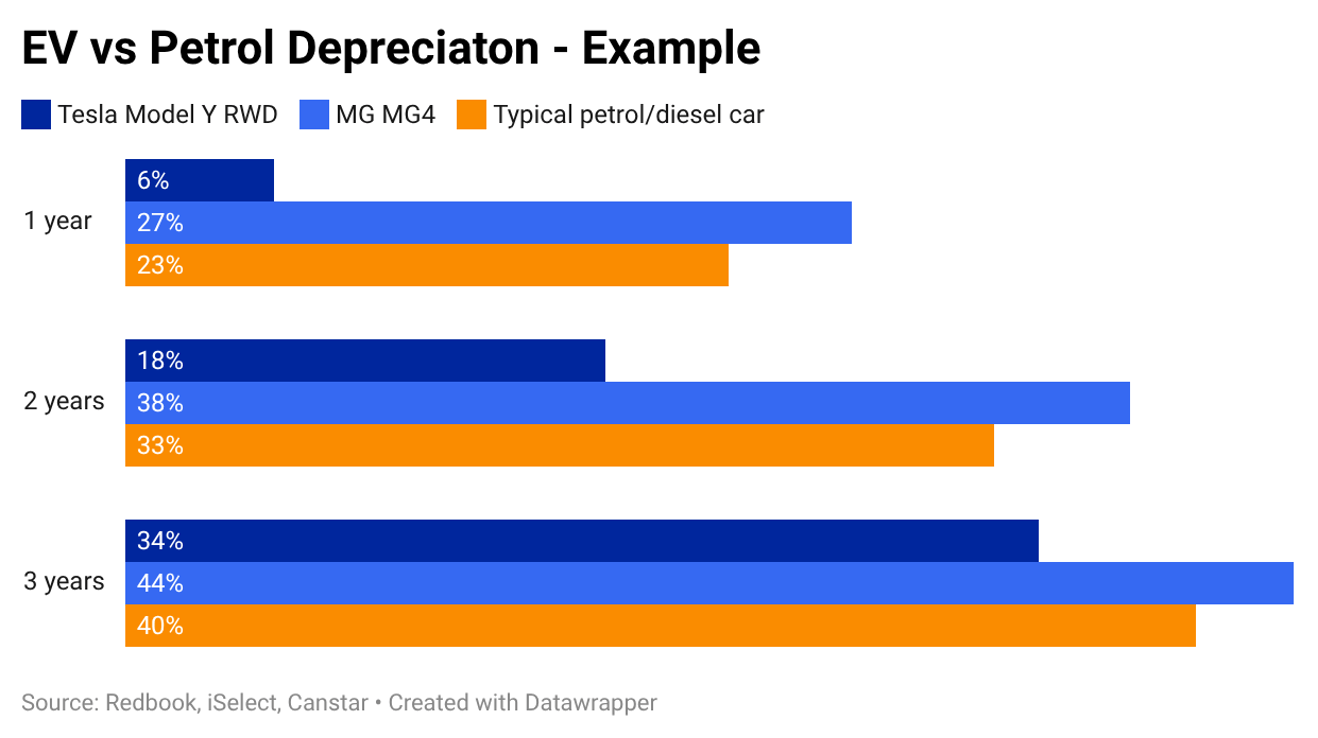
The Tesla Model Y depreciated less than the industry average petrol or diesel benchmark at every age we checked. At one year old, it had lost just 5.5% of its value, against a benchmark of 22.5%. At three years old, it had lost 34.1%, still under the 40% benchmark. Part of this is a genuine result. Part of it is a quirk of falling new car prices. Tesla cut the price of the Model Y over this period, so a newer model year often looks artificially cheap when new, which shrinks its apparent depreciation.

The MG4 depreciated faster than the benchmark at every age we checked. At one year old it had lost 27.1% of its value against a benchmark of 22.5%. At two years old it had lost 37.5% against a benchmark of 32.5%. At three years old it had lost 43.7% against a benchmark of 40%. Some of that gap may reflect the small inconsistencies in the underlying listing data, such as the change in motor output between model years, rather than age alone.

So do EVs have lower resale values than petrol cars? Not necessarily, it also depends on the model. Some EVs hold their value close to what you would expect from a petrol car. Others may depreciate faster, particularly cheaper models from newer brands where new car prices are still settling.

Why people think EVs lose value faster

A few things feed the perception that EVs are worse for resale, even when the data is mixed.

Battery degradation worries. Buyers worry an older EV will have a battery that cannot hold charge like it used to. In practice, most EVs are backed by battery warranties of around eight years or 160,000 km, and independent studies of large EV fleets show batteries typically retain more than 80% of their original capacity after eight years. The fear is often bigger than the real world risk, but it still affects what buyers are willing to pay.

Fast moving technology. EV range, charging speed and software improve quickly. A three year old EV can feel outdated next to a new model with better range and faster charging, which pushes buyers toward newer stock and away from older EVs.

Manufacturer price cuts. When brands like Tesla cut the price of a new car, the value of every older version on the used market drops to match. This is not really about the used car losing quality. It is a flow on effect from the new car market, and it can happen quickly and without warning.

A small used EV market. EVs still make up a small share of used car sales in Australia. A thin market means prices can swing more with shifts in buyer demand, compared to established petrol models with years of trading history behind them.

Higher purchase prices. Many EVs historically cost more than an equivalent petrol car to begin with. Even where the percentage of depreciation is similar, the dollar amount lost can look larger simply because the starting price was higher. This however is less relevant today as EVs have reached price parity across many models in most segments.

What this means for a novated lease

If you are taking out a novated lease, resale value works a little differently to buying a car outright.

Novated lease residual values are set using the ATO’s minimum residual value tables, based on the length of your lease. They are not directly tied to the open market resale price on the day your lease ends. This gives you more certainty over what you will owe at the end of the lease, regardless of how the used EV market moves in the meantime.

On top of that, an EV under the luxury car tax threshold is exempt from fringe benefits tax under a novated lease. That saving can offset a chunk of any extra depreciation, especially over a typical three to four year lease term.

If you are weighing up an EV against a petrol car for your next novated lease, it is worth running the numbers on your specific situation. You can get a quote using the Flare Cars calculator to see how the savings stack up for the model you are considering.

What this means for you

EVs are not automatically worse for resale value. Some models hold their value close to a typical petrol car. Others depreciate faster, often for reasons tied to a fast moving market rather than the car itself. The safest approach is to check the specific model you are considering rather than relying on the general myth.

If you want to compare EV and petrol options side by side for a novated lease, try the Flare Cars calculator to see estimated costs and savings based on your own numbers.

Resale value is one of the biggest worries buyers raise about EVs. The idea is that electric cars lose value faster than petrol or diesel cars, so you end up worse off when you sell.