Login

High-Kilometre EVs Hold Up Better Than Petrol Cars, Major Study Finds

Author: Danny Thai   |   6 Nov 2026

Most used car buyers get nervous once the odometer passes 100,000km. A new UK study suggests that rule may not apply to electric cars.

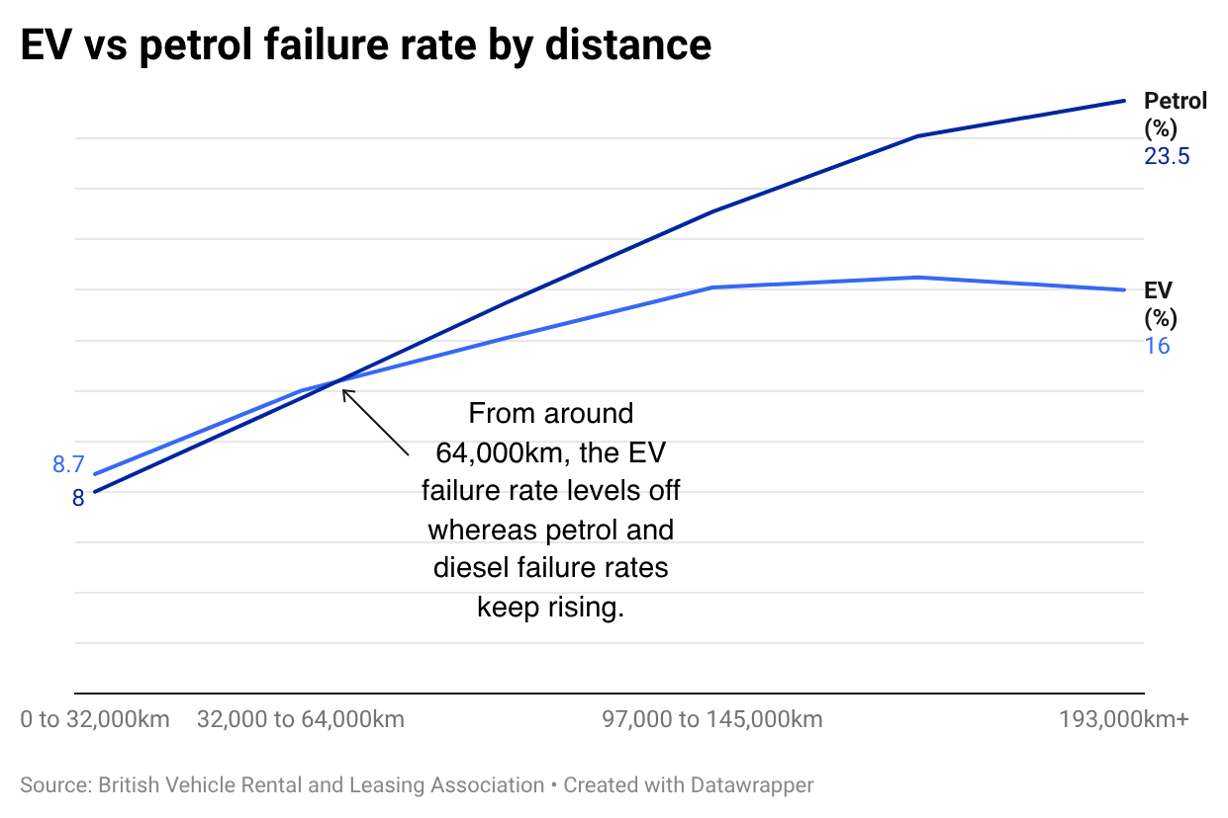
Research commissioned by the British Vehicle Rental and Leasing Association (BVRLA) analysed 47.4 million UK roadworthiness tests (known as MOTs). It found that once cars pass roughly 97,000km, EVs become much less likely to fail than petrol cars of the same age and distance travelled.

The research was carried out by independent transport research group New AutoMotive using official UK government test records. It was published on 22 September 2026.

What the Study Found

At lower distances, there was little difference between EVs and petrol cars. Between about 32,000km and 64,000km, 12.0% of EVs failed their test, compared with 11.7% of petrol cars.
The gap opens up as kilometres climb. From around 97,000km, the EV failure rate levels off at about 16%,whereas petrol and diesel failure rates keep rising.

Distance travelled

EV failure rate

Petrol failure rate

32,000 to 64,000km

12.00%

11.70%

145,000 to 193,000km
(cars aged 3 to 8 years)

16.50%

22.10%

Over 193,000km

16.00%

23.50%

In the 145,000km to 193,000km range, that makes EVs around 25% less likely to fail than petrol cars.

The researchers compared cars of the same age and the same distance travelled. This matters. EVs on UK roads are much younger than the petrol fleet on average, so a simple comparison of headline failure rates would be misleading.

New AutoMotive chief executive Ben Nelmes said the result points to the simpler design of an electric drivetrain. With no engine, gearbox or exhaust to wear out, there are fewer parts to fail as the kilometres add up.

Older EVs Stay on the Road Longer

The study also confirmed that older EVs stayed on UK roads longer than petrol cars.

At 15 years old, 94.6% of EVs came back for their next test, compared with 88.1% of petrol cars. That means 5.4% of EVs left the road at that age, against 11.9% of petrol cars. Leaving the road can mean being scrapped, exported or taken off the road, so not every car that drops out of the data has been scrapped.

Older EVs were also being used more. EVs covered more kilometres each year than petrol cars at every age from four to 16 years. At 12 years old, EVs travelled about 7,900km a year on average, compared with about 7,100km for petrol cars.

Where EVs Did Worse

EVs did however perform worse than petrol and diesel equivalent vehicles in a few categories.

Tyres – EVs recorded about 1.8 times as many tyre defects as petrol cars. The problem was worse in some earlier EVs built on platforms designed for petrol cars. EVs are heavier and deliver torque instantly, so tyres can wear faster. As EVs becoming increasingly built on dedicated EV platforms with lighter and more efficient drivetrain, these numbers should come down.

Brakes on low-use cars – High-kilometre EVs had far fewer brake defects. But older EVs with low kilometres showed more problems with their brakes, likely from corrosion. Regenerative braking means the physical brakes get used less, and parts that sit idle can rust.

Suspension – There was no sign that extra weight hurts EV suspension. Between about 97,000km and 145,000km, EVs had 4.7 suspension defects per 100 tests, compared with 6.1 for petrol cars.

Battery Health Wasn't Tested, But Australian Data Provides Context

This is the main limit of the study. UK roadworthiness tests check brakes, tyres, suspension, steering and lights. They don’t measure battery health, battery wear or charging speed.

So the study shows high-kilometre EVs hold up well mechanically. It doesn’t tell you how much range an individual car has lost. Recent Australian market data however helps fill that gap. Since October 2023, Pickles has tested more than 250 used EVs across Australia’s major capital cities. On average, the batteries kept most of their capacity, even at higher kilometres:

Distance travelled

Average battery capacity retained

Under 20,000km

98.20%

40,000 to 80,000km

94.60%

120,000km

90.10%

For context, 120,000km is about 10 times the distance the average Australian car covers in a year. EVs older than four years still kept at least 93% of their original battery capacity on average.

What This Means for Australian Buyers

Australia doesn’t have a national annual roadworthiness test like the UK, so there’s no equivalent local dataset. But the cars are largely the same, and the findings are relevant for anyone looking at a used EV here.

Many used EVs now coming onto the Australian market are ex-fleet or ex-lease cars. These often have higher kilometres than a privately owned car of the same age. Based on this research, high kilometres alone shouldn’t rule a car out.

If you’re looking at a used EV, check:

  • Battery health – Ask for a state of health (SoH) report from the dealer or an independent tester.
  • Tyres – Look at tread depth and when they were last replaced.
  • Brakes – Especially on older, low-kilometre cars that may have sat unused.
  • Service and warranty history. Confirm how much of the battery warranty is left. Many run for eight years.

Can You Get a Used EV on a Novated Lease?

Yes. Used EVs can be packaged through a novated lease, and some qualify for the FBT exemption.

To be eligible, the EV must be under the luxury car tax threshold for fuel-efficient vehicles and must have been first held and used on or after 1 July 2022. A used EV first sold before that date doesn’t qualify for the exemption.

That means a two to four year old ex-fleet EV with higher kilometres could be a cheaper way to get the FBT savings, as long as the battery and condition check out.

👉 Ready to see the numbers? Get an EV novated lease quote and find out how a new or used EV fits your weekly budget.

Resale value is one of the biggest worries buyers raise about EVs. The idea is that electric cars lose value faster than petrol or diesel cars, so you end up worse off when you sell.