Login

Toyota Hilux BEV Buyer's Guide: Everything You Need to Know

Author: Danny Thai   |   29 July 2026

Quick Verdict

The Hilux BEV is Toyota’s first electric ute for Australia. It will suit fleet and government buyers running predictable, depot-based routes or tradies who have moderate towing and payload requirements with a regular place to charge.

Pros

Cons

Five-star ANCAP rating.

Payload of 715-725kg is well below the diesel

Full FBT exemption on a novated lease.

Braked towing capacity of 2000kg is far short of the diesel's 3500kg

V2L output of 1.5kW, useful for running tools or job site equipment.

Limited driving range (real-world 250-270km).

Extensive Toyota dealer and service network.

Thinking about how a Hilux BEV would stack up on a novated lease against a diesel model or another ute?
Run the numbers on the Flare Cars calculator to see weekly cost and any FBT savings side by side.

Pricing & Variants

The Hilux BEV line-up is priced from $74,990 to $82,990 plus on-road costs. It features three variants, all dual cab, all dual motor all-wheel drive.

Variant

Body style

Price (before on-roads)

SR

Dual cab-chassis

$74,990

SR

Dual cab pickup

$76,490

SR5

Dual cab pickup

$82,990

Every Hilux BEV comes with the same dual-motor AWD powertrain. This makes the electric range the most expensive in the Hilux family, sitting above even the range-topping diesel Rogue and Rugged X, which top out at $71,990 before on-roads.

Premium paint adds $675, and the colour range is limited to two whites and one grey. Buyers financing through a novated lease also get a complimentary 7kW home wallbox charger included.

Deciding between the SR and SR5, or between a diesel and electric Hilux, often comes down to weekly cost rather than sticker price. Compare lease options for each variant using the Flare Cars calculator.

Design & Practicality

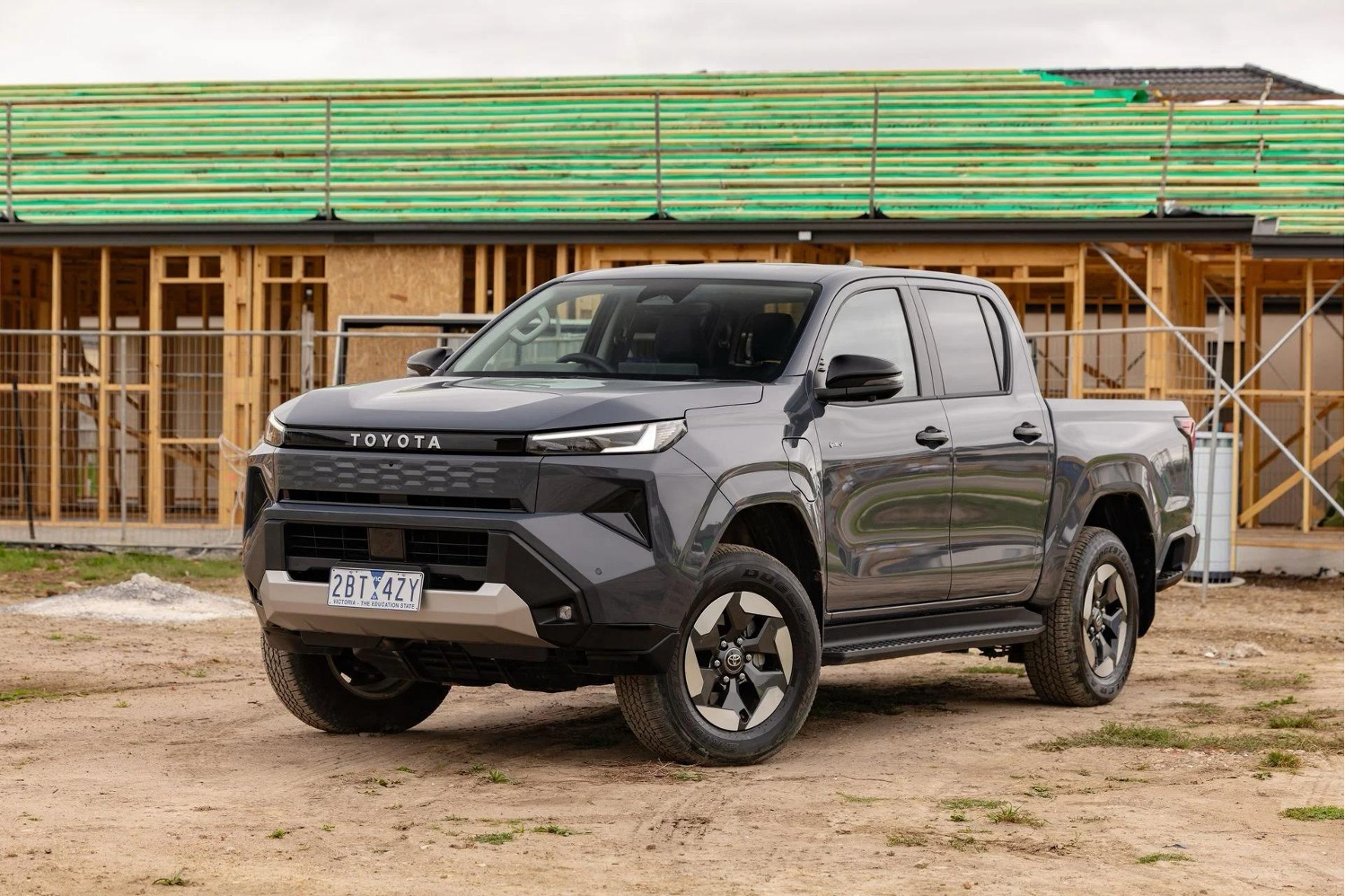
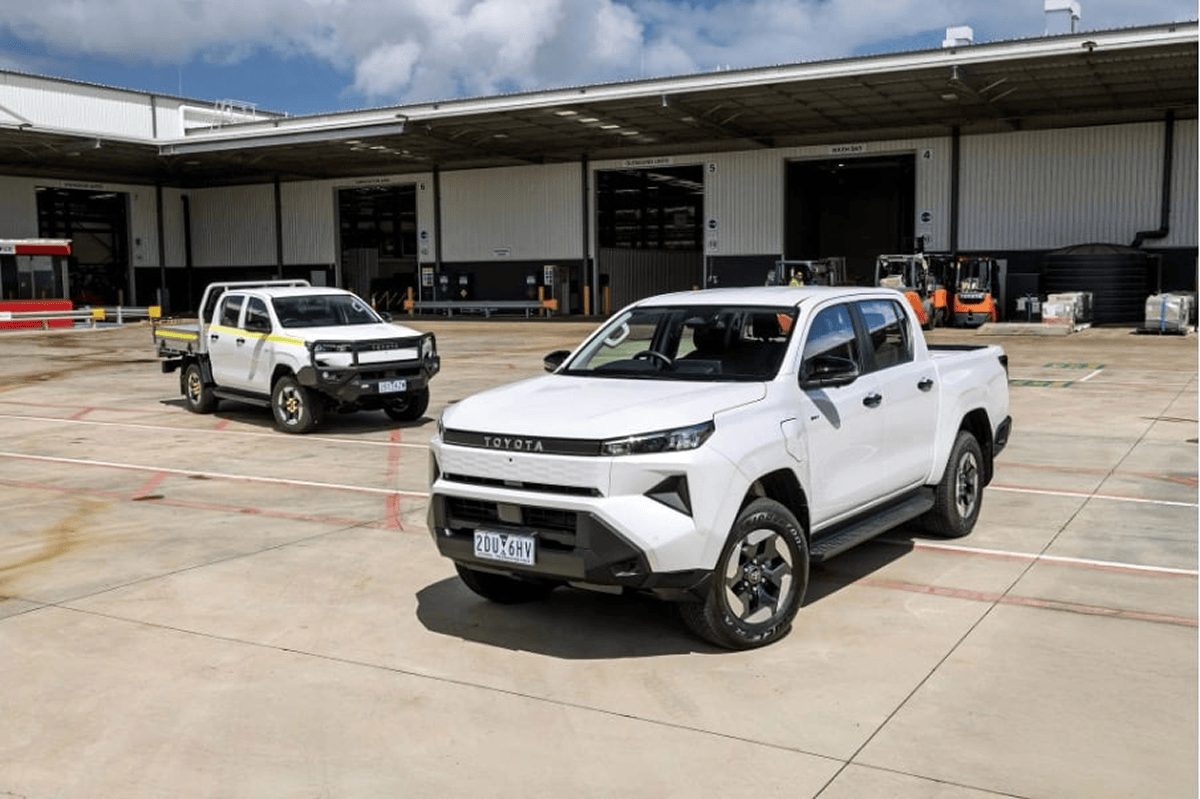
The Hilux BEV shares its body and cabin with the ninth-generation diesel Hilux, with a few visual differences. It gets a closed upper grille, since there is no engine to cool the same way, and aero-style 17-inch alloy wheels. Underneath the electric Hilux gets additional reinforcements and new suspension to protect the battery pack and support its additional weight.

The tray matches the dimensions of the diesel Hilux, so existing tub liners, canopies and tie-down accessories should carry across. There is no frunk. The front motor bay is fully occupied, so all storage remains in the tray and cabin as normal.

Overall dimensions are 5325mm long, 1855mm wide and 1800mm high, in line with a standard dual-cab Hilux. Cabin trim, screens and storage follow the same layout as the rest of the current Hilux range.

Powertrain, Range & Charging

Limited range and the need to charge regularly are what hold back the electric Hilux use case in the real world.

Battery and range. The 59.2kWh usable battery is small for such a large body, which limits driving range. Toyota claims up to 315km on the NEDC cycle. Converted to WLTP, a standard closer to real-world driving, expect closer to 250 to 270km unladen, and under 200km loaded, towing, or at highway speed. Toyota is positioning this ute for back-to-base fleet duty cycles rather than long-haul or remote work, and the range figures back that up.

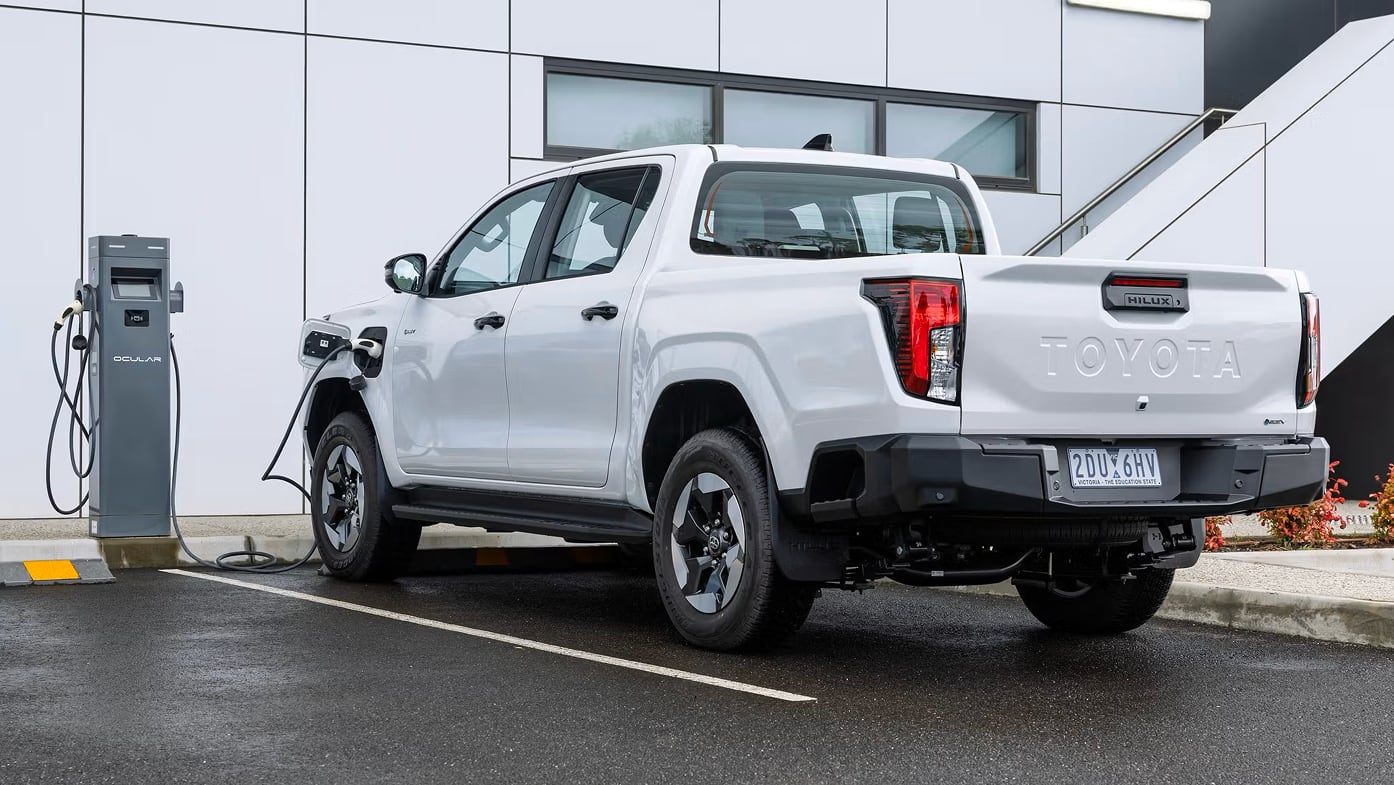
Charging. DC fast charging tops out at 150kW, taking 10 to 80 percent in around 30 minutes. AC charging at home or a depot takes roughly 6.5 hours for 10 to 100 percent. High-mileage tradies working regional routes should check DC fast charger coverage before committing, since not every corridor has reliable fast charging yet.

Motor and drive modes. Every Hilux BEV is dual-motor AWD, with an 82kW/206Nm front motor and 129kW/269Nm rear motor for a combined 144kW and 468Nm, close to the diesel Hilux. Six terrain modes are available off-road, with torque variably distributed between axles on-road too.

Payload, Towing & Work Capability

In this area, the Hilux BEV, while providing acceptable numbers, falls short compared to the diesel version.

Payload. The SR5 carries 715kg, with other variants up to 725kg. The diesel Hilux carries 935 to 985kg, largely due to the battery’s added weight. For tool-heavy trades or anyone loading building materials regularly, this gap is worth weighing against actual load requirements.

Towing. Braked towing capacity is 2000kg, unbraked 750kg, against 3500kg braked for the diesel. Anyone pulling a trailer, box trailer, or small caravan near that limit will find the Hilux BEV a step down, and towing near capacity cuts further into the already modest range.

Vehicle to load. V2L output of 1.5kW can run smaller tools, lighting, or job site equipment directly from the battery, removing the need for a separate generator on smaller jobs.

If payload and towing are close to your daily requirements, model both a diesel and electric Hilux side by side before deciding. The Flare Cars calculator can show how the lease cost difference stacks up against the capability trade-off.

How It Compares

The only other fully electric dual-cab ute on sale in Australia right now is the KGM Musso EV. It takes a very different approach: a lighter, car-based unibody platform rather than a body-on-frame ute, which trades some off-road toughness for better range, payload and a lower price.

Toyota Hilux BEV

KGM Musso EV

Price

$74,990 to $82,990 (before on-roads)

$60,000 to $64,000 drive-away

Platform

Body-on-frame, dual-motor AWD only

Unibody, 2WD or dual-motor AWD

Battery

59.2kWh usable

80.6kWh LFP

Claimed range

Up to 315km NEDC (~250 to 270km WLTP-equivalent)

420km WLTP (2WD), 380km WLTP (AWD)

Payload

715 to 725kg

905kg (2WD), 805kg (AWD)

Braked towing

2000kg

1800kg

Ground clearance

218 mm

181mm

ANCAP

5-star

Not yet rated

On paper the Musso EV wins on price, range and payload. Where the Hilux BEV pulls ahead is body-on-frame construction, higher ground clearance, a five-star ANCAP rating already confirmed, and the depth of Toyota’s dealer and service network. For fleets that value uptime and established support the Hilux has the Musso EV beat despite its superior driving range. For private buyers on a budget, the Musso EV offers a cheaper way into an electric ute.

Running Costs & Business Case

Servicing. Six-month service intervals are shorter than most owners expect from an EV. Capped-price servicing runs around $2200 over five years. This compares to $3050 over five years for the diesel Hilux. This is a smaller saving over diesel than typical for an EV, mainly due to the same six-monthly service cadence.

FBT exemption. Every Hilux BEV variant sits below the $91,661 fuel-efficient luxury car tax threshold for 2026-27, so it qualifies for the full FBT exemption on a novated lease, under rules in place until 31 March 2027. Combined with pre-tax salary packaging, this is usually where an electric ute makes the strongest financial case over diesel.

Charging cost vs diesel. For high-mileage tradies, fuel savings can be significant when charging at home or a depot. Savings narrow with public DC charging, but still stack up against diesel.

Resale and depreciation. Data is too limited to say much here. This is a first-generation electric ute in a market that has run almost entirely on diesel, so there’s no established resale data or depreciation curve to point to yet.

Want to see how the FBT exemption plays out on your salary and kilometres? Use the Flare Cars calculator to get a real weekly figure rather than a rule of thumb.

Who Should Buy It (and Who Shouldn't)

Buy it if you’re a fleet or government buyer running a back-to-base duty cycle, charging overnight at a depot, without regularly hauling near payload or towing limits. The FBT exemption, five-star ANCAP rating and Toyota dealer network make a strong case here.

Think twice if you tow regularly, carry heavy tools and materials daily, or drive long distances between jobs without reliable charging along the way. The diesel or hybrid Hilux still wins on payload, towing and range.

Whichever way you’re leaning, compare the actual weekly cost of a Hilux BEV against a diesel Hilux or the Musso EV on your own numbers. The Flare Cars calculator takes salary, kilometres and lease term into account so you can see the real difference, not just the sticker price.

The Hilux BEV is Toyota’s first electric ute for Australia. It will suit fleet and government buyers running predictable, depot-based routes or tradies who have moderate towing and payload requirements with a regular place to charge.